
School Grants
The Jill Hughes Bequest is a legacy initiative of The Mathematical Association of Western Australia (MAWA), funded through the estate of Jill Hughes.
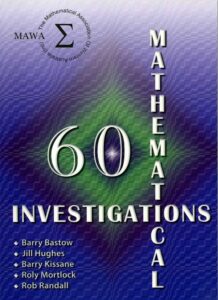
Jill was an active member of MAWA and was bestowed life membership in 1996. Jill was a former President, and she made major contributions to the activities of the Association. She was one of the authors of the groundbreaking publication, 60 Mathematical Investigations. She worked very closely with Edith Biggs, the former Her Majesty’s Inspector of Mathematics who was a major consultant to the project of revising the Primary Mathematics Syllabus in the mid-1970s.
Jill Hughes was a committed advocate for mathematics education in Western Australia. Her bequest enables MAWA to support schools in strengthening mathematics teaching and expanding meaningful learning opportunities for students — particularly those who face the greatest barriers to success.
Objectives of the Bequest
The Jill Hughes Bequest provides financial support to Western Australian schools for initiatives that:
- Provide financial support for innovative projects that improve mathematics teaching and learning.
- Encourage sustainable programs that can be scaled or replicated across schools and communities.
- Support student participation in mathematics events, competitions, and enrichment activities.
- Strengthen the long-term capacity of schools and educators to deliver high-quality mathematics education, particularly for disadvantaged cohorts.
Eligibility
Applications are open to MAWA member schools in Western Australia, including primary, secondary and combined schools. Applications must be submitted by a school representative. Individual student applications are not accepted.
Preference may be given to:
- Schools located in rural or remote areas of Western Australia.
- Schools with an ICSEA score below 1000, serving students from low socioeconomic backgrounds.
- Schools leading and supporting culturally responsive practices.
What Can Be Funded?
The Bequest supports activities directly related to mathematics education.
Eligible activities may include:
- Student participation in mathematics workshops or programs including support with travel costs.
- Professional learning activities, including support with travel costs, and related resources focused on mathematics teaching.
- Community mathematics initiatives to engage families and students.
Examples of Supported Activities
The examples are provided as a guide only.
- Have Sum Fun – support to travel to a regional competition
- MAWA Problem Solving Program – support registration costs for individual students or to conduct a regional class
- WA Maths School – support with travel and registration costs
- Professional Learning – support with facilitator fees and travel
- MAWA Conferences – support with travel and registration costs
- Interschool mathematics activities
- School-based mathematics enrichment days
- Family mathematics engagement evenings
- Culturally responsive mathematics projects
- Mathematics outreach projects
Application Process and Key Dates
The Jill Hughes Bequest operates through one application round each year.
The annual application timeline is as follows:
- Applications open: 1 February
- Applications close: 15 April
- Assessment period: 16 April-15 May
- Applicants notified: 16 May-31 May
- Offers and payments: Processed by 30 June
Schools are encouraged to plan their proposed activities in advance and ensure their applications are submitted by the closing date. Late applications will not be considered in the annual round.
Grant funding must be used within the funding period, ending 30 June of the year following the successful application. Any unspent funds at that date may need to be returned to MAWA, subject to the grant conditions.
Selection and Accountability
Applications are assessed through a competitive process based on demonstrated financial need, alignment with the objectives of the Bequest, anticipated impact on disadvantaged, regional or remote students, and the potential for sustainable outcomes and longer-term benefits to mathematics education.
Meeting the eligibility requirements does not guarantee funding. The amount and allocation of funding will depend on the quality of applications, demonstrated need and the funds available.
Successful applicants must provide an acquittal report outlining how the funding was used and the outcomes achieved.
Funding Information
Funding amounts may vary depending on the nature and scale of the project. The expected maximum grant amounts are $1500 for a project from a single school or $5000 for a network of schools.
All funding is subject to the competitive assessment process and the availability of funds.
Continuing Jill Hughes’ Vision
Through the Jill Hughes Bequest, MAWA honours Jill’s commitment to strengthening mathematics education and ensuring all Western Australian students have access to high-quality mathematics learning opportunities.
By supporting innovative projects, professional learning and meaningful student engagement, the Bequest aims to help schools overcome barriers, build capacity and create lasting opportunities for students to succeed in mathematics.
Frequently Asked Questions
Applications for the Jill Hughes Bequest open annually on 1 February and close on 15 April. Applications are assessed from 16 April to 15 May, with applicants notified after 16 May. Grant offers and payments will be processed by the end of Term 2.
Only MAWA member schools in Western Australia are eligible to apply.
Grants of up to $1,500 for a single school or $5,000 for a network of schools may be available, depending on the nature and scale of the proposed project. All applications are assessed competitively, and funding is subject to demonstrated need, alignment with the objectives of the Bequest and the availability of funds.
Yes. Networks of schools are encouraged to apply for collaborative projects that strengthen mathematics teaching and learning across schools or communities. Applications must be submitted by a representative of a MAWA member school, and the proposed project should demonstrate its anticipated impact, sustainability and benefits for participating students and educators. Grants of up to $5,000 may be available for a network of schools.
Teacher release time may be considered where it is directly related to an eligible mathematics education initiative, such as professional learning, project development or implementation. Applicants should clearly explain why the release time is necessary, how the funding will be used and the anticipated benefits for mathematics teaching and learning. All costs must be justified in the application and will be subject to the assessment process.
Yes. The Bequest may support student participation in MAWA programs and activities, including the MAWA Problem Solving Program, WA Maths School and other relevant mathematics enrichment opportunities. Funding may contribute to registration fees and associated travel costs, where appropriate. Applications should demonstrate the financial need, expected student benefits and alignment with the objectives of the Bequest.
Successful applicants must submit an acquittal report outlining how the grant funding was used and the outcomes achieved. The report should demonstrate how the funded activity supported mathematics teaching and learning and explain the benefits for participating students, educators or the wider school community.
All grant funding must be used by 30 June of the year following the successful application. Applicants should retain relevant expenditure records and ensure the funds are used for the approved purpose.